Price Alert Launch
A new Pepperstone feature letting traders seamlessly set, manage and track real-time price alerts — so they never miss a market move.
Helping traders catch the moment
Currently the price alert functionality is not supported on native app. Our clients lack the ability to set and manage price alerts to monitor the price movements of symbols of interest from their mobile devices. However this functionality is supported in our webtrader platform and by extending this on mobile as well we aim to bridge the gap and tackle the inconsistency in the user experience.
In the trading world, price alerts is a fundamental feature to support in any trading platform as without this users may miss critical market opportunities, leading to reduced trading frequency and a suboptimal trading experience. If we wish to remain competitive and enhance our user engagement and overall user experience it’s essential to offer a real-time Price alert functionality within the mobile applications.
Designed for emerging and mainstream traders
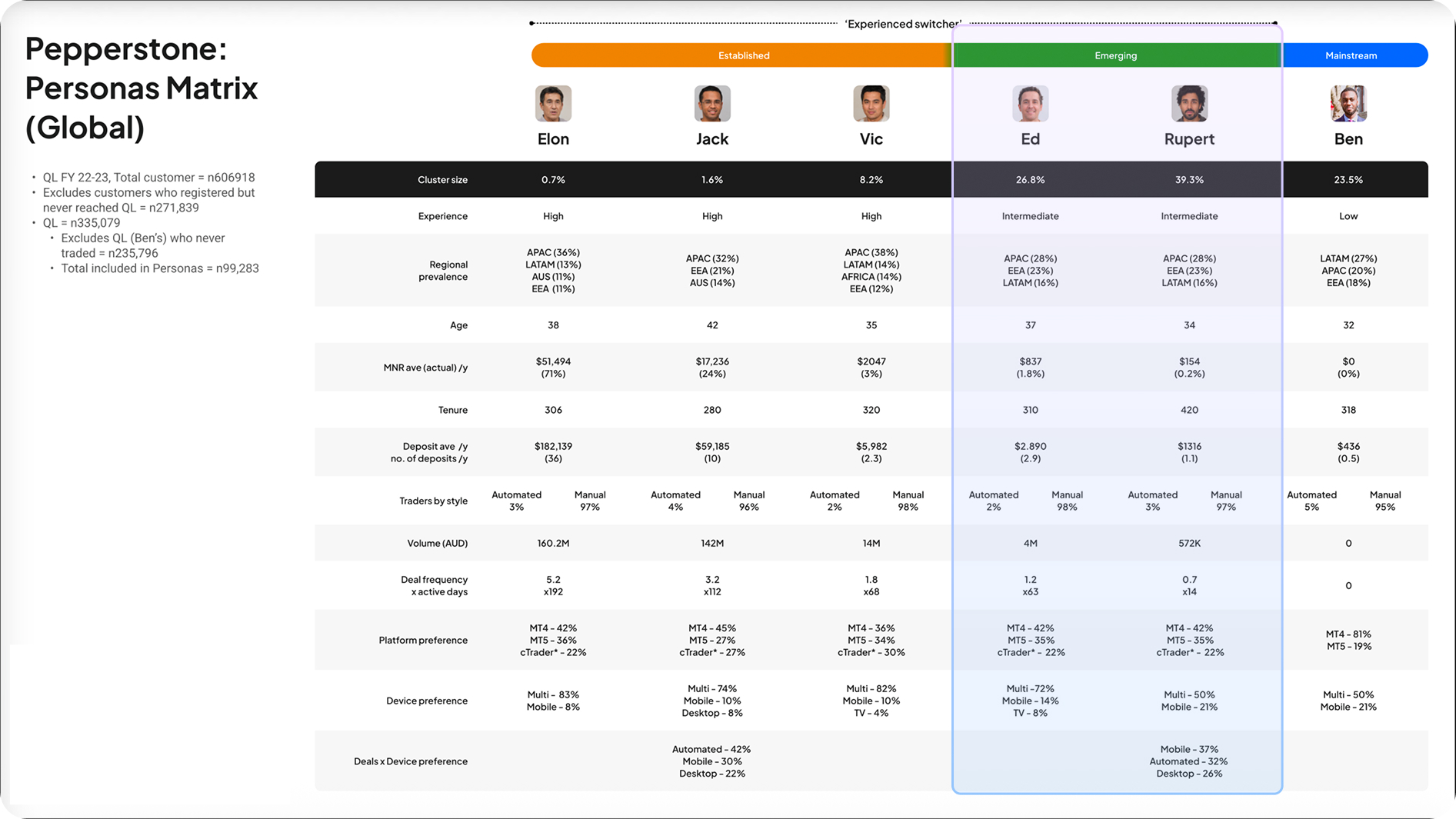
The emerging segment is defined by Ed and Rupert — two intermediate, manual traders who together make up roughly 66% of customers but only about 2% of revenue. They are younger (37 and 34 years old), long-tenured, APAC-led (28%), and mostly trade on MT4/MT5.
Ed is low-value but active: 63 active days per year and $837 MNR. His behaviour is the one to amplify, so he is the primary target. Rupert is low-value and dormant: 14 active days per year and $154 MNR, despite the longest tenure. His inactivity is likely structural, so he is a test group rather than a given.
The whales hold roughly 95% of revenue, but they have no headroom. The emerging segment has the gap between current and potential value — the only place a mobile growth feature can move the needle. The strategy is to lead with Ed, treat Rupert as the experiment, and measure alert-to-trade conversion rather than taps.
Caveat: cluster-size percentages and sample-size notes do not fully reconcile — confirm the source before using externally.
A complete alert experience
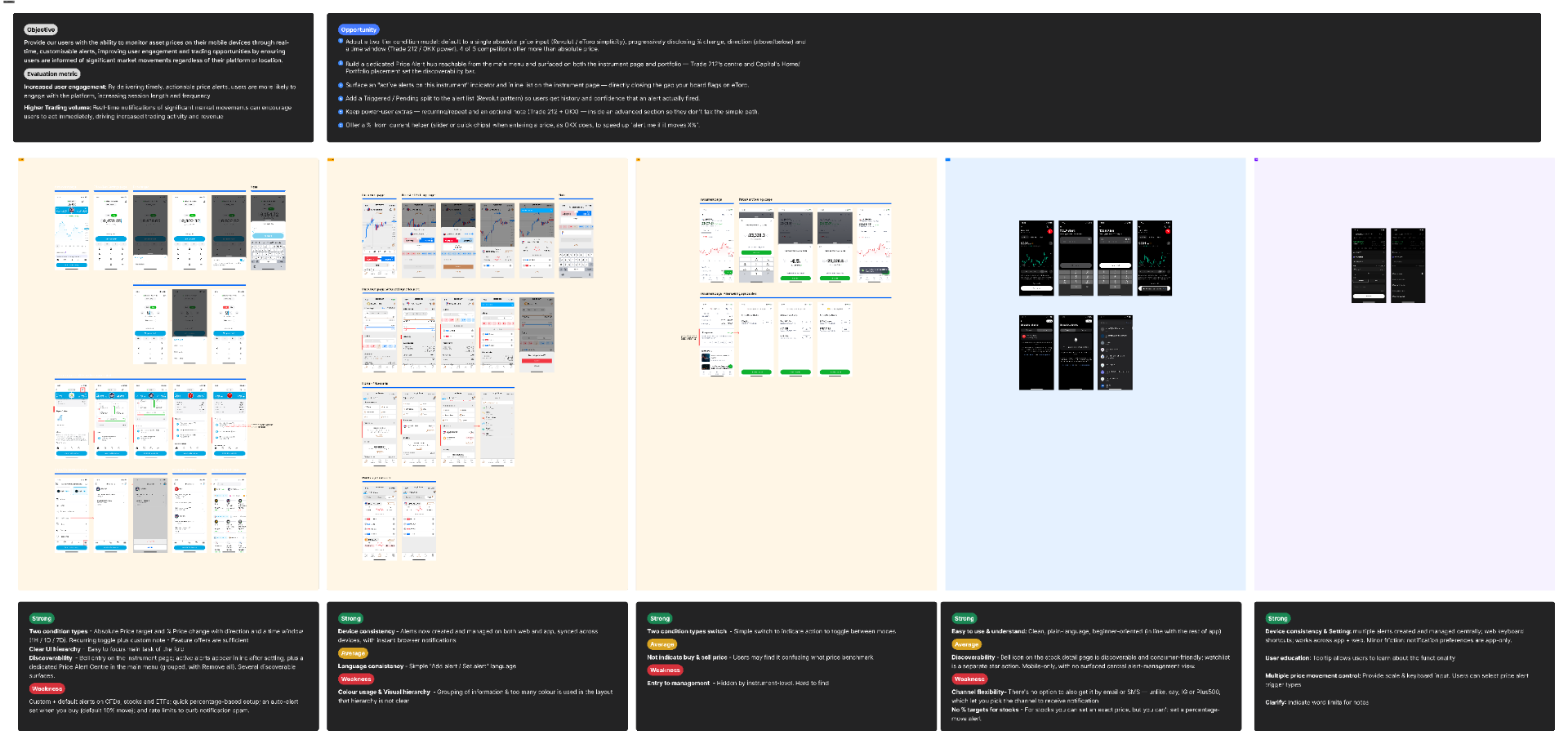
Set alerts directly from the chart, watchlist or instrument page. Manage everything in one place — active, triggered and paused — and receive timely push and in-app notifications that link straight back to the trade. Designed to feel native to the existing trading flow, not bolted on.
Set price alert
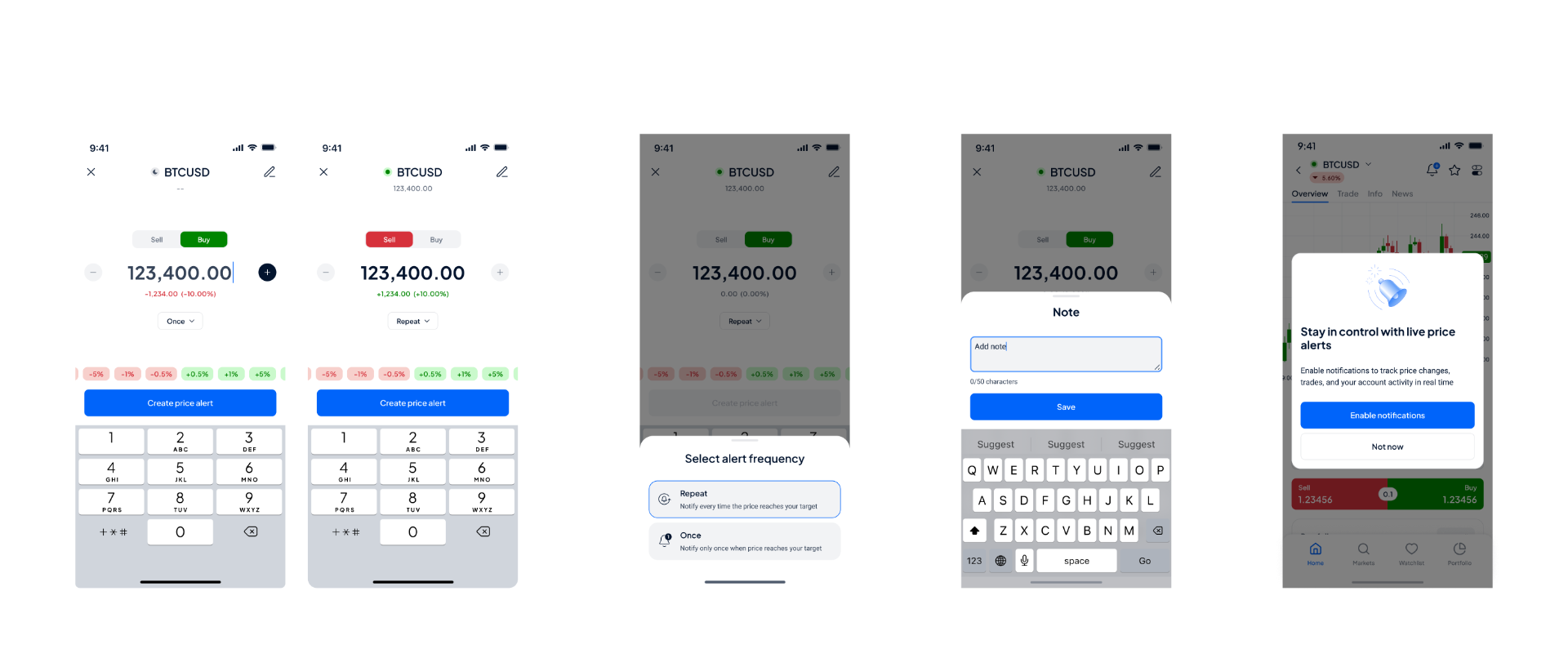
Set price alerts based on whether the price moves above or below a pre-filled value. Quick-pick shortcut tabs (±0.5, 1, 2, 5, 10, 15, 20) scroll horizontally for one-tap entry.
Set trigger frequency
Set 'Triggered once' (One-off) as the default alert mode. Allow users to switch between a one-time notification and recurring alerts depending on their preferred frequency.
Add notes
Tap the pen icon to open a free-text field for adding reference notes.
Notification
When a user sets a price alert while notifications are disabled, prompt them to turn on notifications in their device settings.