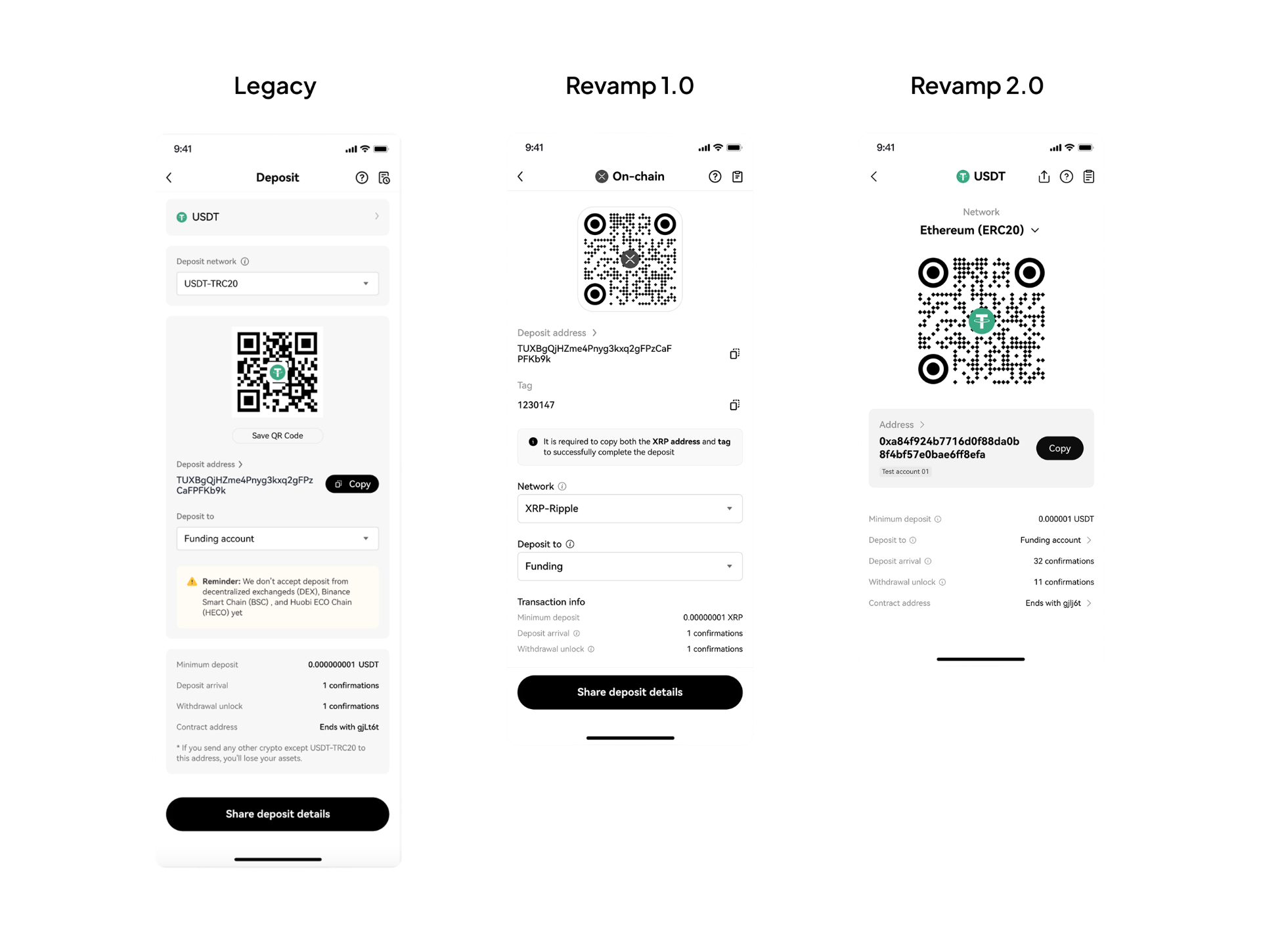
Crypto Deposit Experience
Revamp
Rebuilt the on-chain deposit flow — network selection, address, and confirmation — into a guided journey that cut failed deposits by 42% and slashed support tickets.
A critical touchpoint falling short of expectations
The Deposit module within the Assets section is one of OKX's most critical user touchpoints — serving approximately 100K daily active users and enabling core platform activities including trading and financial product subscriptions. Despite its scale, the legacy deposit flow was falling significantly short of user expectations.
Deposits not crediting
Of all weekly deposit and withdrawal inquiries to customer service were related to deposits not crediting — disproportionately affecting new users unfamiliar with crypto deposit mechanics.
Failed first deposit
UXR onboarding metrics showed that 42% of KYC-verified users failed to complete a successful first deposit — a substantial drop-off at the most fundamental moment in the user journey.
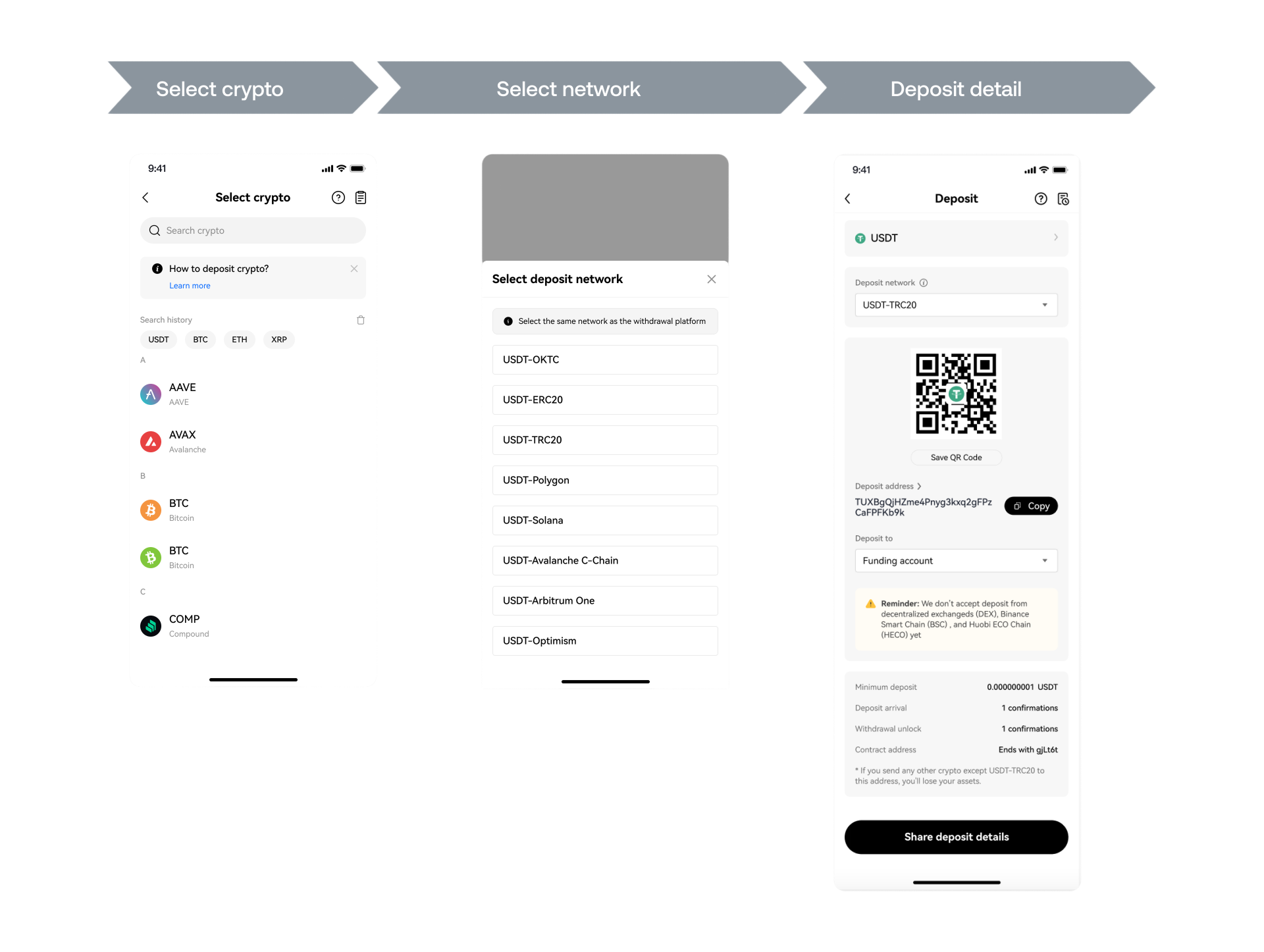
Understanding where the flow broke down
To understand user behaviour across the deposit flow and surface usability issues in the legacy experience, the Assets Product Design team partnered with UXR to conduct structured research with 12 participants — split across two profiles: new-to-crypto users and experienced crypto users.
End-to-end experience mapping — observations were synthesised into a full journey map identifying where users struggled, hesitated, or failed across the deposit flow.
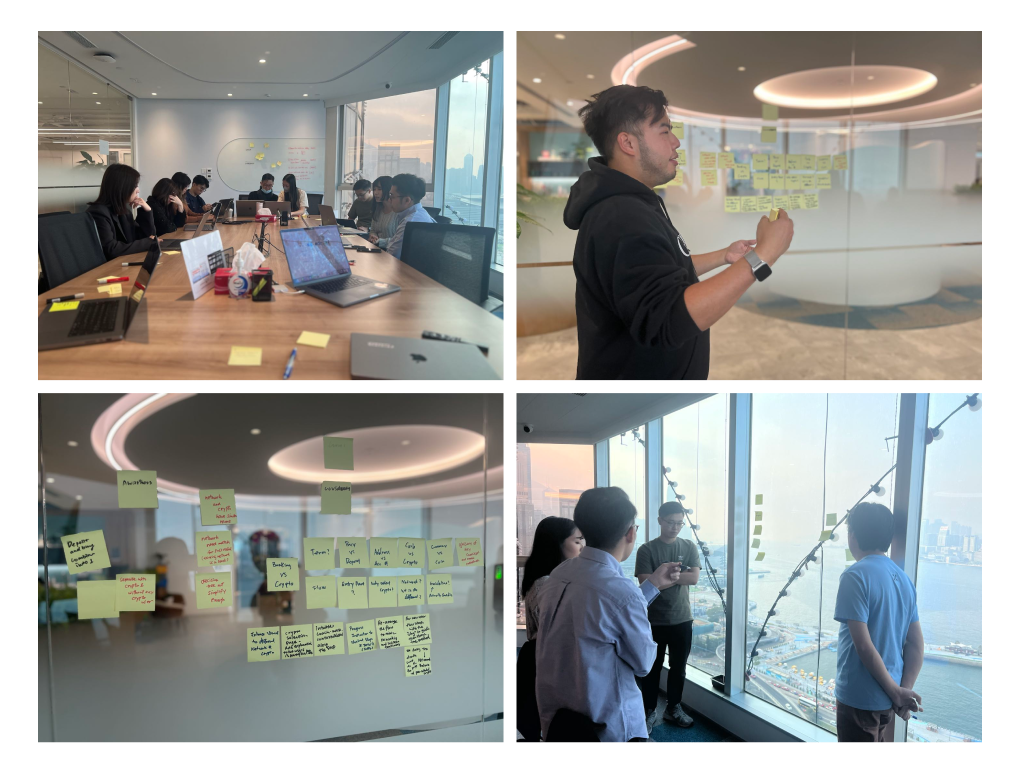
A collaborative ideation & prioritisation session with PM, Engineering, UXR, Product Design, and Customer Service on upcoming deposit enhancements.
Surfaced directly from UXR research and Customer Service ticket data — every issue traced back to a real user moment.
Individual enhancements gathered from the session, consolidated into 10 themes to guide design and engineering prioritisation.
Three problems surfaced above the rest
The research consolidated into 48 individual enhancements across 10 themes. Three critical usability issues emerged from usability testing.
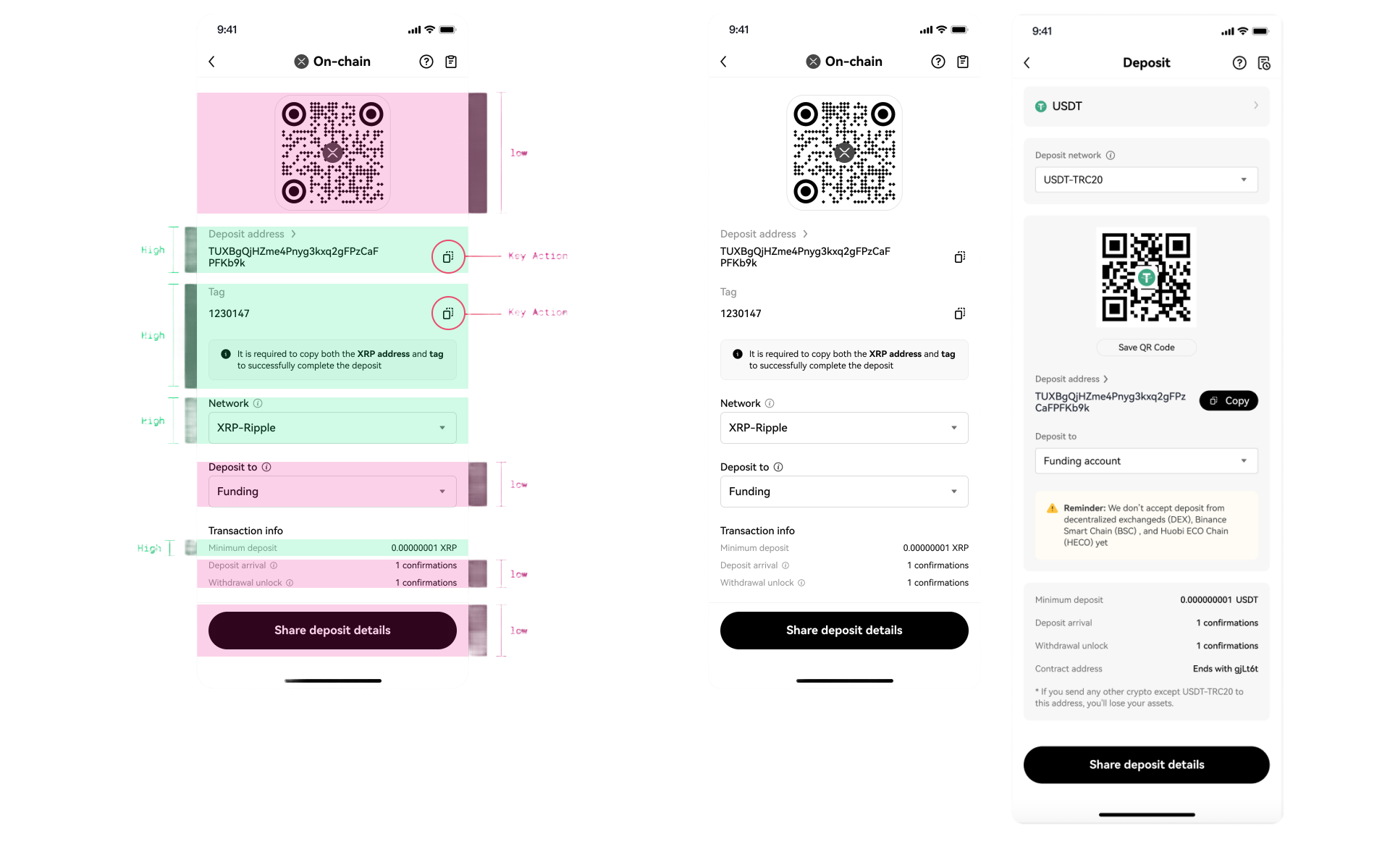
Inefficient information architecture
Primary selections — "Select Crypto" and "Select Network" — occupied 70% of the first fold, pushing critical information such as minimum deposit amount, deposit arrival time, withdrawal unlock conditions, and contract address entirely below the fold.
Unrecognisable call-to-action elements
Key interactive elements were not perceived as actionable by users. Many participants failed to recognise the coin card as a tappable button — indicating a fundamental affordance breakdown in the UI.
Missing Tags & Memo visibility
Tags and Memos for the selected crypto and network pair were not surfaced at the point of need — creating confusion and increasing error risk for users completing transfers.
Every scenario, mapped and documented
All deposit scenarios were mapped and documented in full to prepare for engineering implementation — covering edge cases, empty states, error handling, and the complete range of crypto and network combinations.
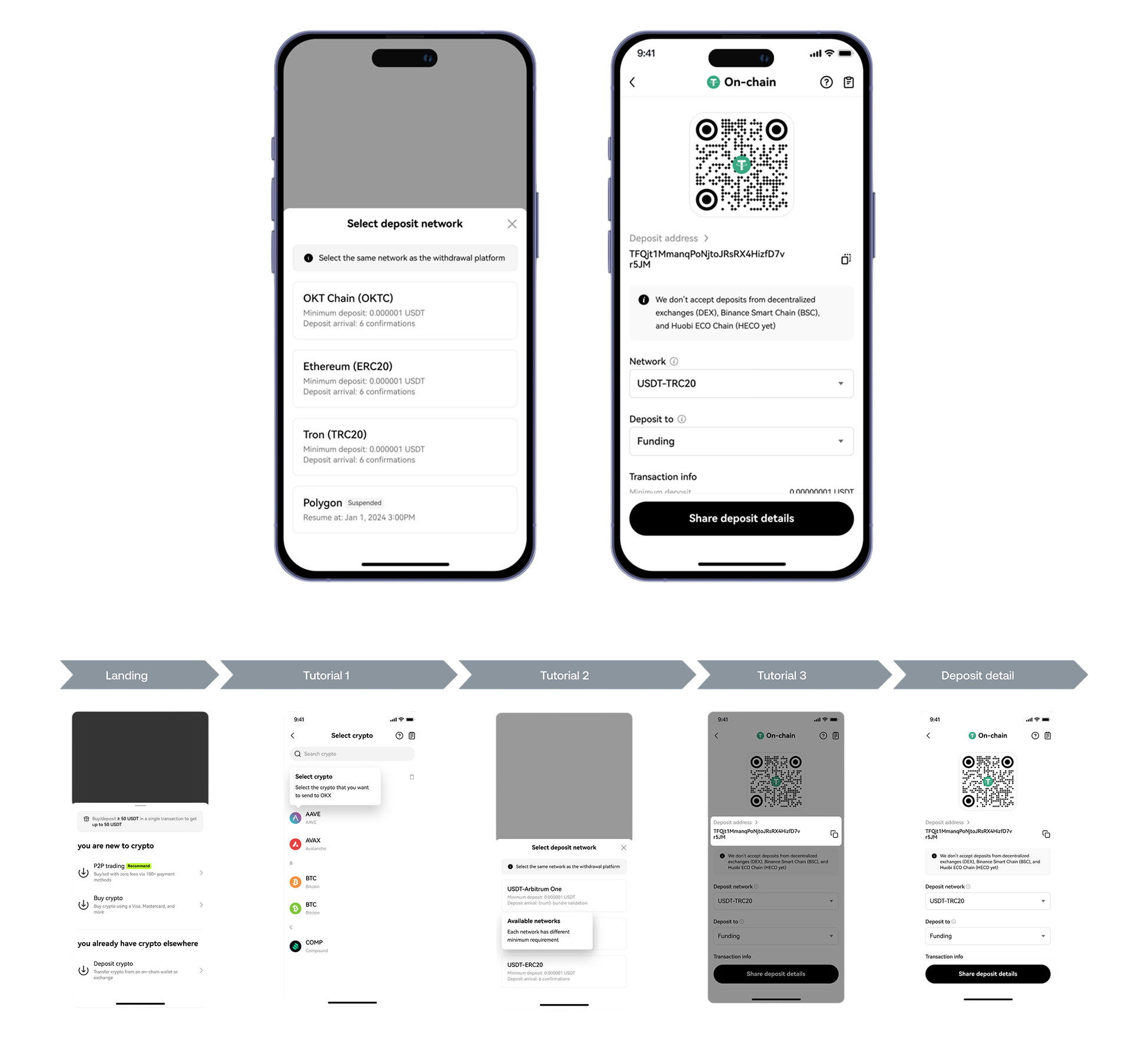
Measuring efficiency and effectiveness
Evaluation metrics were designed to measure two things: the efficiency of users reaching the Deposit Detail page, and the effectiveness of users completing a deposit action.
Data was tracked across the period of April 21 to July 24
Conversion — Select crypto → Deposit detail
- Drop-off (Select network → Detail)2.75% → 0.25%
- Increase+3.01%
Convert time — Select crypto → Deposit detail
- Improved by45.45%
Conversion — Select crypto → Copy
- Web surpassing app—
- Overall increase+18.62%
Convert time — Select crypto → Copy
- Improved by58.33%
Support tickets — "Deposit doesn't credit"
41,297 tickets, ~0.16% of overall deposit transactions.
- Memo / tag issue~23.1%
- Below minimum amount~21.7%
- Unsupported token~17%
FTD completion rate (KYC'd users)
Treatment vs Control — conversion rate increased by 7.39%. Top-3 new-user countries:
- China FTD+2.0% (18.87% → 19.26%)
- Nigeria FTD+7.5% (6.88% → 7.42%)
- Indonesia FTD+7.7% (13.8% → 14.93%)
The work didn't stop at launch
A post-launch iteration cycle was initiated in July 2024 following an internal evaluation, currently live to 5% of user traffic. The pursuit of a simpler, more reliable deposit experience remains active — each cycle bringing the flow closer to what users need it to be.